IPTV Middleware is one of the most important technical components behind modern IPTV platforms. While users typically see an IPTV application, TV interface, channel list, EPG, VOD library, or login screen, middleware often works behind the scenes to connect the user interface with the IPTV backend.
If you are learning about IPTV technology, you will encounter terms such as IPTV middleware software, IPTV middleware server, IPTV middleware platform, Stalker Middleware, Stalker Portal, Ministra TV Platform, MAG IPTV Middleware, IPTV Portal URL, MAC authentication, EPG middleware, and VOD middleware. Understanding how these technologies interact can make IPTV architecture much easier to understand.
In simple terms, IPTV middleware acts as a management and communication layer between IPTV users, devices, applications, content servers, and backend systems. It can handle authentication, subscriptions, device management, channel organization, electronic program guides, video-on-demand catalogs, user interfaces, and APIs.
This guide explains what IPTV middleware is, how IPTV middleware works, its architecture, major components, Stalker Middleware, Ministra, MAG systems, API functionality, user management, EPG and VOD management, and the differences between middleware, M3U, and Xtream Codes.
Important: IPTV middleware is a technology layer. It does not automatically provide television channels or subscriptions. Use IPTV platforms and content only when you have the appropriate authorization.
What Is IPTV Middleware?
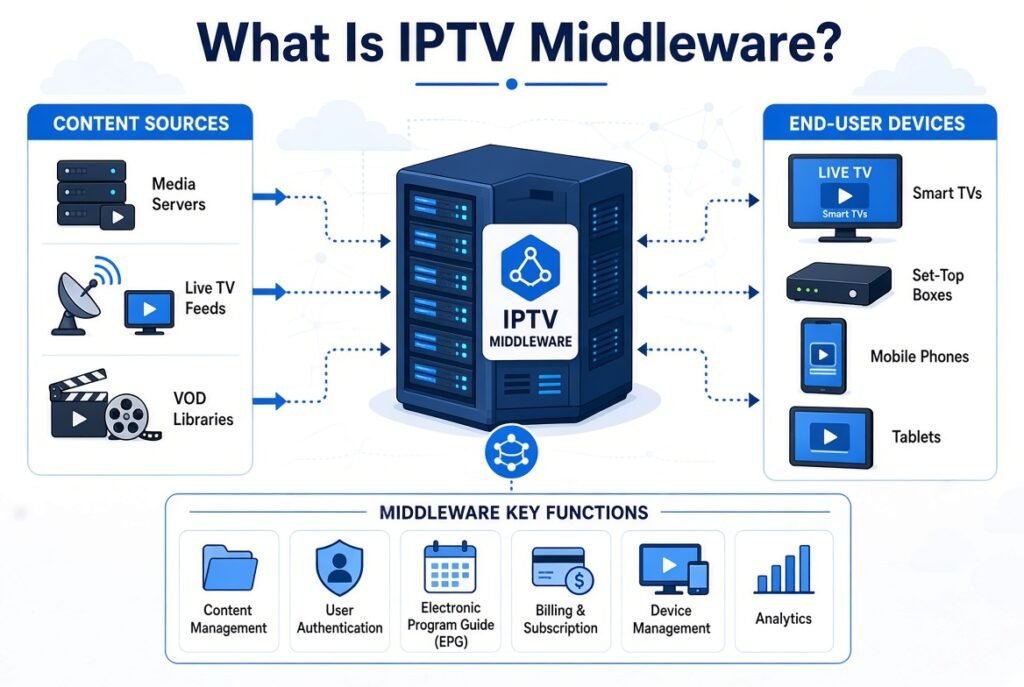
IPTV middleware is software that sits between an IPTV service’s backend infrastructure and the applications or devices used by customers.
It provides the logic and management functions required to operate an IPTV platform.
A simplified IPTV architecture looks like this:
User Device → IPTV Application → Middleware → Backend/Content Infrastructure → Streaming Server
The middleware can control how information is presented to the user and how devices interact with the IPTV platform.
Depending on the platform, middleware may manage:
- User accounts
- Device authentication
- Subscriptions
- Channel categories
- EPG data
- VOD catalogs
- Series
- Favorites
- Parental controls
- Catch-up TV
- Device limits
- Portal access
- API communication
- Content metadata
This makes middleware much more than a simple IPTV player.
IPTV Middleware Software
IPTV middleware software provides the management layer required to operate an IPTV platform.
A middleware solution may contain several components:
User Management
Administrators can manage users, devices, packages, permissions, and account status.
Device Management
The system can associate devices with users or subscriptions.
Depending on the platform, authentication may use:
- MAC addresses
- Username and password
- Tokens
- Application credentials
- API authentication
Content Management
Middleware can organize content into categories such as:
- Live TV
- Movies
- Series
- Sports
- News
- International content
- VOD
EPG Management
Middleware can connect channels with electronic program guide data.
Subscription Management
Operators can define subscription packages, expiration dates, device limits, and access permissions.
What Is an IPTV Middleware Server?
An IPTV middleware server hosts the software responsible for managing the IPTV platform’s application logic and user interactions.
It may communicate with:
- Authentication databases
- Streaming servers
- VOD storage
- EPG sources
- CDN infrastructure
- User databases
- Payment systems
- IPTV applications
- Set-top boxes
The middleware server does not necessarily deliver the actual video stream itself.
A common architecture separates:
Middleware Server → Management and Authentication
from:
Streaming Infrastructure → Video Delivery
This separation allows platforms to scale different components independently.
How Does IPTV Middleware Work?
The basic workflow can be simplified into several stages.
1. User opens an IPTV application
The application connects to the IPTV platform.
2. Authentication occurs
The middleware verifies the user’s credentials or device information.
3. User permissions are checked
The platform determines what content and features the account can access.
4. Content information is returned
The middleware provides metadata such as channel names, categories, logos, EPG information, and VOD catalogs.
5. The player requests the stream
The IPTV application connects to the appropriate streaming infrastructure.
6. Video playback begins
The actual stream is delivered to the user’s device.
This separation is important because middleware and streaming servers have different responsibilities.
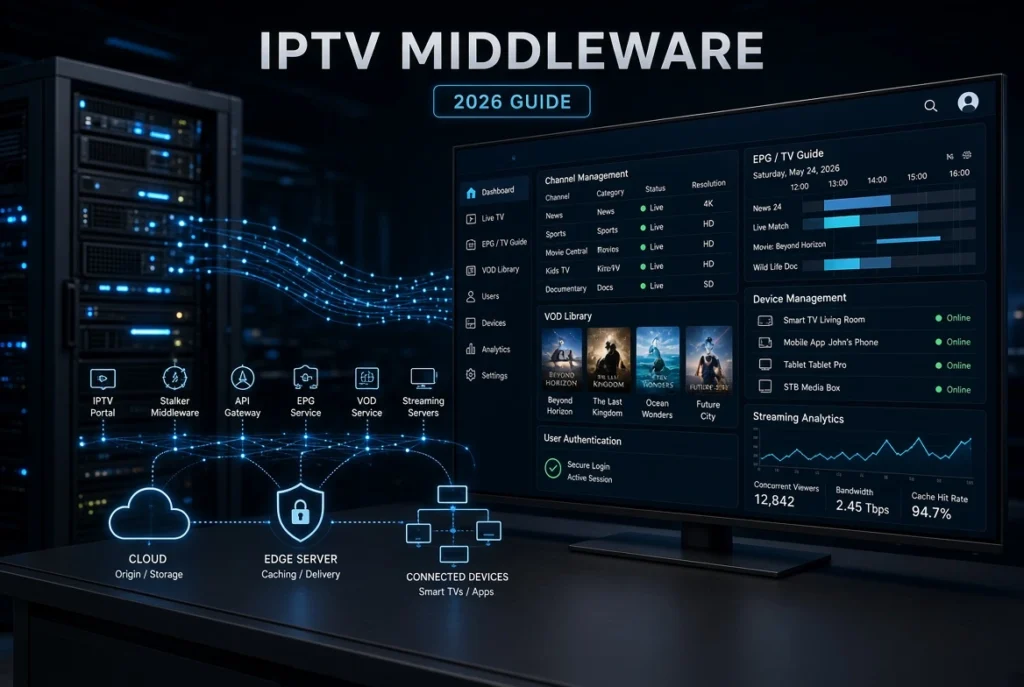
IPTV Middleware Architecture
A modern IPTV middleware architecture can contain several layers.
Client Layer
This includes:
- Smart TVs
- Android TV
- Google TV
- Fire TV
- Set-top boxes
- Mobile devices
- Web applications
Application Layer
This contains IPTV applications and interfaces.
Middleware Layer
This handles:
- Authentication
- User management
- Device management
- Content organization
- EPG
- VOD
- APIs
- Subscription rules
Backend Layer
This can contain:
- Databases
- Authentication services
- Content management systems
- Billing systems
- APIs
Streaming Layer
This handles video delivery through technologies such as:
- HLS
- MPEG-DASH
- MPEG-TS
- CDN infrastructure
A simplified architecture is:
Client → Application → Middleware → Backend → Streaming Server/CDN
IPTV Middleware API
An IPTV middleware API allows applications and other systems to communicate with the middleware platform.
An API can expose functionality such as:
- User authentication
- Account information
- Channel lists
- VOD catalogs
- EPG information
- Device information
- Subscription status
- Content metadata
The exact API endpoints and authentication mechanisms depend on the middleware platform.
Developers should always consult the official documentation for the specific middleware implementation rather than assuming that every IPTV platform uses the same API.
Stalker Middleware
Stalker Middleware is a well-known middleware technology associated with IPTV portals and compatible set-top boxes.
It became particularly associated with MAG devices and portal-based IPTV systems.
A Stalker-style environment can provide:
- Device authentication
- IPTV portal functionality
- Live TV organization
- VOD
- EPG
- User management
- Device management
One important concept is that Stalker Middleware is middleware, not an IPTV player and not an IPTV subscription.
Stalker IPTV Middleware
Stalker IPTV Middleware provides a management environment between compatible IPTV clients and the backend IPTV infrastructure.
A compatible device may connect to a portal URL, authenticate, and receive the information required to display the IPTV interface.
This is why terms such as:
- Stalker Portal
- Stalker Middleware
- MAG Portal
- MAC Portal
- IPTV Portal
are often discussed together.
However, they are not necessarily interchangeable terms.
Stalker Portal IPTV
A Stalker Portal is a portal endpoint through which compatible IPTV devices or applications can communicate with the middleware platform.
A typical portal-based architecture looks like:
Device → Portal URL → Middleware → Authentication → IPTV Backend
The exact implementation depends on the middleware and service configuration.
Ministra TV Platform
Ministra TV Platform is another IPTV middleware platform associated with the ecosystem historically surrounding Stalker Middleware.
It provides tools for managing IPTV services and can support functions such as:
- Subscriber management
- Device management
- Live TV
- VOD
- EPG
- User interfaces
- Content organization
The exact functionality available depends on the platform version and deployment.
Ministra IPTV
Ministra IPTV environments can provide a centralized management system for IPTV services.
Instead of configuring every device independently, an operator can manage many elements from a central backend.
This can include:
- Users
- Devices
- Packages
- Content
- EPG
- VOD
- Access rules
MAG IPTV Middleware
MAG devices are strongly associated with portal-based IPTV middleware.
A MAG-style IPTV system can use:
MAC Address + Portal URL + Middleware
The MAC address identifies the device, while the portal URL tells the device where the middleware is located.
The middleware then handles the authentication and service interface.
IPTV Portal Middleware
An IPTV Portal Middleware provides the infrastructure behind a portal-based IPTV experience.
It may control:
- Portal authentication
- Device registration
- User accounts
- Channel categories
- EPG
- VOD
- Subscription permissions
The portal is therefore more than simply a URL. The URL points to an application environment powered by middleware.
IPTV Portal URL
An IPTV Portal URL is the address used by a compatible IPTV client to connect to the middleware.
It can look conceptually like:
or another provider-defined endpoint.
The exact URL structure varies between platforms.
A portal URL should come from the authorized service operator. Random portal URLs found online may be unavailable, unsafe, or unauthorized.
IPTV MAC Authentication
IPTV MAC authentication is a device-based authentication method commonly associated with MAG and portal-based systems.
The middleware can associate a device’s MAC address with an account or service configuration.
The basic process is:
MAC Address → Portal → Middleware → Authentication → Authorized Service
This differs from traditional M3U authentication, where a playlist URL provides access to streams.
IPTV Device Authentication
Middleware can support different authentication mechanisms depending on the platform.
Examples include:
- MAC address
- Username/password
- API token
- Session token
- Device ID
- Application credentials
Device authentication helps an IPTV platform determine whether a client is authorized to access its services.
IPTV User Management
One of the major benefits of middleware is centralized user management.
An IPTV operator can potentially manage:
- User accounts
- Account status
- Expiration dates
- Subscription packages
- Device associations
- Permissions
- Connection limits
This is much more scalable than manually configuring every device.
IPTV Subscription Management
Middleware can connect users to subscription packages.
For example, an operator might define different packages with different access permissions.
The middleware can then determine which services are available to a specific account.
Possible subscription properties include:
- Start date
- Expiration date
- Device limit
- Package type
- Content permissions
- Account status
IPTV EPG Middleware
IPTV EPG middleware manages electronic program guide information.
The EPG can contain:
- Program titles
- Start times
- End times
- Program descriptions
- Channel identifiers
- Program metadata
Middleware can associate EPG information with channels so that applications can display a structured TV guide.
IPTV VOD Middleware
IPTV VOD middleware manages video-on-demand catalogs.
Instead of simply displaying a list of streams, the middleware can organize VOD content into:
- Categories
- Movies
- Series
- Seasons
- Episodes
- Genres
- Posters
- Descriptions
The actual video files may be stored and delivered by separate media infrastructure.
IPTV Middleware vs M3U
M3U is primarily a playlist format, while middleware is a management platform.
| IPTV Middleware | M3U |
|---|---|
| Management platform | Playlist format |
| User management | Channel/stream list |
| Device authentication | Usually URL/file based |
| Subscription management | Limited metadata |
| EPG management | Can reference EPG metadata |
| VOD management | Can contain VOD links |
| APIs | Not inherently an API |
An M3U playlist can be one component of an IPTV system, but it does not replace a full middleware platform.
IPTV Middleware vs Xtream Codes
Xtream Codes terminology is commonly used for an IPTV API/login architecture, while middleware describes a broader management layer.
An Xtream-style system can provide structured access to:
- Live TV
- VOD
- Series
- EPG
- Account information
Middleware can include these capabilities plus additional management functions.
Therefore:
M3U = playlist format
Xtream Codes = structured IPTV login/API approach
Middleware = broader IPTV management platform
The exact terminology can vary between IPTV implementations.
IPTV Middleware Not Working
If an IPTV middleware platform is not working, the problem can originate from several layers.
Client-side problems
- Internet connection
- Incorrect configuration
- Outdated application
- Device compatibility
- DNS problems
Authentication problems
- Invalid credentials
- Device not registered
- Expired account
- Incorrect MAC address
Middleware problems
- Server outage
- Database issue
- API failure
- Authentication service failure
Streaming infrastructure problems
- Origin server issue
- CDN problem
- Network congestion
- Stream unavailable
This layered approach makes troubleshooting much easier.
IPTV Middleware Troubleshooting
When troubleshooting middleware, check the system layer by layer.
Step 1: Check internet connectivity
Make sure the device can access the internet.
Step 2: Verify the portal or server address
Check that the configured endpoint is correct.
Step 3: Verify authentication
Confirm that the account or device is authorized.
Step 4: Check middleware availability
If multiple users experience the same problem, the issue may be server-side.
Step 5: Check streaming infrastructure
If login works but video does not play, investigate the streaming server, CDN, or stream format.
Step 6: Check EPG and metadata separately
A working stream does not necessarily mean that EPG services are working.
IPTV Middleware Setup
Setting up IPTV middleware is significantly more complex than configuring an IPTV player.
A complete deployment can involve:
- Server infrastructure
- Middleware software
- Database
- Authentication system
- Content management
- Streaming infrastructure
- EPG system
- VOD storage
- CDN
- Monitoring
- Security
- APIs
For a production IPTV platform, the middleware must be designed to handle the expected number of users and devices.
IPTV Middleware Configuration
Important configuration areas can include:
Authentication
Define how clients authenticate.
Users
Configure accounts, permissions, and device associations.
Content
Organize channels, VOD, and series.
EPG
Configure XMLTV or another EPG source.
Streaming
Define how applications access streams.
API
Configure API authentication and access.
Security
Protect administrative interfaces, APIs, accounts, and databases.
Best IPTV Middleware
There is no single best IPTV middleware for every deployment.
The appropriate solution depends on:
- Number of subscribers
- Supported devices
- Required APIs
- VOD requirements
- EPG requirements
- Device authentication
- Scalability
- Security
- Budget
- Technical expertise
A small private deployment may require a very different architecture from a large commercial OTT platform.
IPTV Middleware Open Source
Some organizations investigate IPTV middleware open source solutions because they want greater control over the platform.
Potential advantages include:
- Customization
- Source-code access
- Community development
- Integration flexibility
- Control over deployment
However, open-source software still requires technical expertise for:
- Installation
- Security
- Updates
- Database management
- Server administration
- Scaling
- Monitoring
Open source does not automatically mean easier.
IPTV Middleware User Interface
The IPTV middleware user interface is the visual layer users interact with after authentication.
It can include:
- Home screen
- Live TV
- TV Guide
- VOD
- Series
- Favorites
- Search
- Settings
- Account information
A well-designed interface should make navigation fast and intuitive, especially on TV remotes.
IPTV Middleware and CDN
Middleware and CDN infrastructure serve different purposes.
Middleware manages users, devices, content metadata, authentication, and application logic.
CDN distributes video content closer to viewers through geographically distributed edge servers.
A scalable IPTV architecture can therefore look like:
User → IPTV App → Middleware → Streaming Platform → CDN → Video
The middleware controls the service experience, while the CDN helps deliver media efficiently.
IPTV Middleware Security
Security should be a major consideration when deploying IPTV middleware.
Important measures include:
- HTTPS
- Strong administrator credentials
- Secure API authentication
- Database protection
- Access controls
- Server monitoring
- Regular software updates
- Rate limiting
- Firewall configuration
- Secure backups
Administrative panels should never be unnecessarily exposed to the public internet.
IPTV Middleware API Integration
Middleware APIs can connect the IPTV platform to other systems.
For example, an API may be used to integrate:
- IPTV applications
- Customer management systems
- Billing platforms
- EPG systems
- Analytics
- Device management
- Content management
API integration can significantly reduce manual administration.
IPTV Middleware vs IPTV Player
These two technologies are fundamentally different.
An IPTV player is an application used by the viewer to play IPTV streams.
Examples of IPTV player functionality include:
- Video playback
- Playlist management
- EPG display
- Subtitles
- Favorites
- Audio tracks
Middleware, on the other hand, manages the IPTV platform behind the application.
A simple analogy is:
IPTV Player = Front-end application
IPTV Middleware = Management and service layer
Streaming Server/CDN = Media delivery infrastructure
Frequently Asked Questions About IPTV Middleware
What is IPTV middleware?
IPTV middleware is software that connects IPTV applications and devices with backend systems while managing functions such as authentication, users, subscriptions, EPG, VOD, and content metadata.
What does IPTV middleware do?
It can manage users, devices, subscriptions, authentication, content organization, EPG, VOD, APIs, and the IPTV user interface.
Is Stalker Middleware an IPTV player?
No. Stalker Middleware is middleware used to manage IPTV services and communicate with compatible clients.
What is a Stalker Portal?
A Stalker Portal is an endpoint through which compatible IPTV clients can communicate with Stalker-based middleware.
Is Ministra Middleware?
Ministra is an IPTV/OTT platform that provides middleware functionality for managing IPTV services.
Is M3U middleware?
No. M3U is primarily a playlist format. It does not provide the complete user, device, subscription, and backend management capabilities of middleware.
Is Xtream Codes middleware?
Xtream Codes is commonly associated with an IPTV API/login architecture, while middleware is a broader concept covering the management layer of an IPTV platform.
Does IPTV middleware provide channels?
Not inherently. Middleware manages access and presentation of IPTV services; actual content must come from authorized content and streaming infrastructure.
Why is IPTV middleware important?
Without an appropriate management layer, managing users, devices, subscriptions, EPG, VOD, and application communication becomes much more difficult as an IPTV platform grows.
Conclusion
IPTV Middleware is one of the foundational technologies behind a structured IPTV platform. Although viewers may primarily interact with an IPTV application, middleware can be responsible for many of the functions that make the overall service organized and manageable.
From user authentication and device management to subscriptions, EPG, VOD, APIs, portals, and content metadata, middleware acts as the central management layer connecting the client experience with the IPTV backend.
Technologies such as Stalker Middleware, Stalker Portal, Ministra TV Platform, and MAG IPTV Middleware demonstrate how this concept can be implemented in portal-based IPTV environments. Other IPTV architectures may rely on different platforms, APIs, or authentication mechanisms.
It is also important to distinguish middleware from other IPTV technologies. M3U is primarily a playlist format, while Xtream Codes is commonly associated with structured IPTV credentials and API access. Middleware is broader: it can manage users, devices, subscriptions, content, EPG, VOD, authentication, and communication between different components of an IPTV ecosystem.
A modern IPTV architecture can therefore contain several interconnected layers:
IPTV Application → Middleware → Backend → Streaming Infrastructure → CDN
Each layer has a different responsibility. The application provides the user interface and playback experience. Middleware manages users, devices, content metadata, and authentication. Backend systems handle databases and business logic. Streaming servers process and deliver media, while CDN infrastructure can distribute that media efficiently to viewers around the world.
For anyone studying IPTV technology, understanding middleware is an important step toward understanding the bigger picture. Once you understand how IPTV Middleware, M3U, Xtream Codes, XMLTV/EPG, HLS, MPEG-DASH, CDN, streaming servers, and IPTV applications interact, it becomes much easier to understand how a complete IPTV platform is designed and how problems can be isolated when something goes wrong.
Ultimately, IPTV middleware is not simply another IPTV player or playlist format. It is a core software layer that coordinates the IPTV user experience, authentication, content organization, and backend services. Its architecture, scalability, security, and integration capabilities can have a major impact on the reliability and usability of an IPTV platform.